


Publications
"PhishBENCH: A benchmark for legal tasks related to phishing attacks"
Ioannis Katoikos, Dimitrios Kosmopoulos, Ioannis Iglezakis, Panagiota Kiortsi, George A. Thomopoulos, Christos Fidas
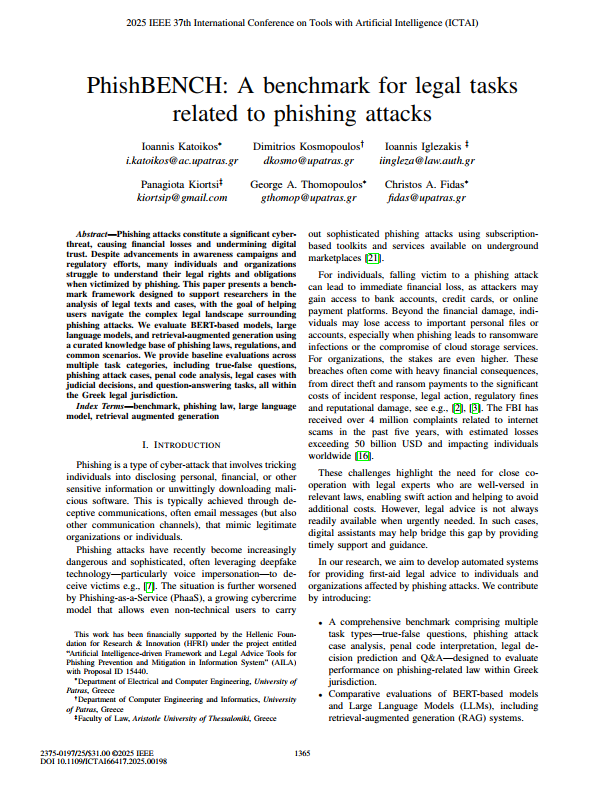
Phishing attacks constitute a significant cyber- threat, causing financial losses and undermining digital trust. Despite advancements in awareness campaigns and regulatory efforts, many individuals and organizations struggle to understand their legal rights and obligations when victimized by phishing. This paper presents a bench- mark framework designed to support researchers in the analysis of legal texts and cases, with the goal of helping users navigate the complex legal landscape surrounding phishing attacks. We evaluate BERT-based models, large language models, and retrieval-augmented generation using a curated knowledge base of phishing laws, regulations, and common scenarios. We provide baseline evaluations across multiple task categories, including true-false questions, phishing attack cases, penal code analysis, legal cases with judicial decisions, and question-answering tasks, all within the Greek legal jurisdiction.
Accepted as full paper in the Proceedings of the "37th IEEE International Conference on Tools with Artificial Intelligence (ICTAI 2025)".
"Regulating Large Language Models (LLMS) Under the EU AI ACT and the GDPR"
Christos Fidas, Dimitrios Kosmopoulos, Georgios Thomopoulos, Ioannis Igglezakis, Panagiota Kiortsi

This paper examines the legal issues arising from the regulation of Large Language Models (LLMs) under Regulation (EU) 2024/1689, the EU AI ACT and the General Data Protection Regulation (GDPR). It highlights that, with advances in technology, LLMs are continuously improving, enabling them to generate more accurate and complex responses. However, ethical and transparency concerns persist regarding their use and potential societal impact, particularly in relation to privacy protection and ensuring objectivity in the processing of personal data.
Published in "Cyberlaw by CIJIC (Cyberlaw Research Centre of the University of Lisbon School of Law)" periodical publication. (ISSN 2183-7295).
“Is regulating LLMs hallucinations elusive? A legal and ethical approach"
Panagiota Kiortsi, Ioannis Iglezakis, Christos Feidas, Dimitrios Kosmopoulos, George Thomopoulos

This paper examines whether hallucinations can be effectively regulated or whether they remain inherently elusive. It first identifies their root causes—biased or incomplete data, semantic misinterpretations, and adversarial attacks—and the risks they pose in high-stakes contexts. It then compares regulatory approaches in the European Union and the United States.
Accepted as full paper at "Computer Ethics: Philosophical Enquiries (CEPE) 2025" Conference, Rome, September 24-26th.
Download the article and the presentation
“A Human–Computer-Interaction Exploration of Working Memory Using EEG”
Konstantina Kyriaki, Christos Fidas

In the context of Electroencephalography (EEG) research, how is Working Memory (WM) leveraged in Human-Computer Interaction (HCI)? To address this question, this paper explores how WM is represented in EEG-based HCI experiments, with the aim of informing interface and system design that more effectively aligns with users’ cognitive capacities and limitations. A total of 132 studies published between 2018 and 2024 were reviewed to identify HCI use-cases involving EEG to study WM, outline key WM concepts, and evaluate how these align with findings from other disciplines. The findings indicate that WM-related EEG studies in HCI aim to enhance user interaction through more efficient signal analysis and the development of adaptive systems and brain-computer interfaces (BCIs). However, the findings also highlight the lack of theoretical grounding for EEG-based WM research within HCI. Key cognitive theories are often overlooked, and the strong association between WM and Attention is rarely acknowledged. Although the neural basis of Working Memory (WM) is well represented, its conceptualization within HCI remains underdeveloped and often misaligned with advances in cognitive science and psychology—potentially limiting the development of safe, effective, and cognitively-aware user-centered technologies. Based on these findings, we recommend: (a) integrating alternative models of Working Memory (WM) into HCI system design; (b) incorporating Attention evaluation in EEG-based WM experiments; and (c) exploring the development of a custom WM foundation model to address conceptual limitations in HCI and variability across tasks, users, and environments
Published in IEEE Access, vol. 13, pp. 157877-157908, 2025, doi: 10.1109/ACCESS.2025.3606802
“The Regulation of Large Language Models (LLMs) in Regulation (EU) 2024/1689 on Artificial Intelligence and the GDPR”
Panagiota Kiortsi, Ioannis Igglezakis, Christos Feidas, Dimitrios Kosmopoulos, Georgios Thomopoulos

This study introduces the legal issues arising from the regulation of Large Language Models (LLMs) in Regulation (EU) 2024/1689 on Artificial Intelligence and the General Data Protection Regulation. It highlights that with technological advancements, the capabilities of dialogue models are continuously improving, allowing them to generate more accurate and complex responses. However, ethical and transparency issues remain regarding how they are used and the impacts they may have on society, especially concerning privacy protection and ensuring objectivity in the processing of personal data.”
Download the article (in Greek)
“Developing an Anti-Phishing Large Language Model: A Focus Group Study on Human, Technological, and Legal Factors”
George A. Thomopoulos, Panagiota Kiortsi, Damianos Dumi Sigalas, Dimitris Kosmopoulos, Ioannis Igglezakis, Christos Fidas

The paper, as part of the AILA project, aims to specify and validate an AI-driven multi factor (human, technology and legal) anti-phishing data model, with the implementation of focus group studies. The findings assist to provide human, technology, and legislative user model endpoints that will be identified and discussed for explicit and implicit user modelling, which will guide the development of the corresponding AI-driven user modelling and profiling mechanisms.
Accepted as full paper at “ISA 2024, 17-19 July, The 15th International Conference on Information, Intelligence, Systems and Applications“, held at Chania, Greece.
“Machine Learning Meets EEG: A Novel Approach to PGA-Based Authentication Systems”
John Katoikos, Christos Fidas, Dimitrios Koukopoulos

The development of secure and effective identification/authentication systems is an ongoing challenge in the field of computer science, as new techniques and methods continue to emerge. In the context of this ever-evolving landscape, we propose a new multi-factor authentication system. The proposed system combines Picture Gesture Authentication (PGA) with simultaneous acquisition of users’ brain signals (EEG) to enhance security. To assess the efficacy of the proposed model, we collected data from 14 individuals, each of whom participated in 20 trials to create a single-person authentication system. Features were extracted and multiple machine learning algorithms were trained and tested in three different scenarios. The first scenario utilized the created dataset to find the most effective machine learning algorithms and features; the second applied augmentation techniques for a more balanced dataset; the third used only the most important features. The results were encouraging, indicating that the proposed model works well in enhancing the level of security.
Accepted as full paper at "2024 International Conference on Machine Learning and Applications (ICMLA)", Miami, FL, USA, 2024, pp. 924-929, doi: 10.1109/ICMLA61862.2024.00135.
“Strengthening Graphical Password Security through EEG-Driven Classifiers Based on Image Content Familiarity”
John Katoikos, Christos Fidas, Dimitrios Koukopoulos

The development of reliable authentication schemes remains up-to date a significant challenge due to security vulnerabilities, such as shoulder-surfing or impersonation attacks. In this paper, we present results of a six-months in-lab study (N=30), during which we designed, developed and evaluated a novel two-factor authentication prototype combining Microsoft’s Picture Gesture Authentication (PGA) with Electroencephalography (EEG) apparatus. The main premise of the study was to investigate whether we can leverage on each users unique neural responses, which are triggered during pictorial content processing within PGA authentication, in order to train individual-based AI-models that would mitigate an impersonation attack (a non-legitimate user trying to get access to a legitimate’s user account by knowing their password credentials). We also investigated whether users’ familiarity with the background image of the PGA scheme, is a significant factor for increased accuracy of personalized AI-driven models. We gathered data from 30 individuals, each completing 20 trials using familiar and unfamiliar background images. After testing various pre-processing, feature extraction, and machine learning algorithms, results indicate that: a) familiar stimuli improves cognitive efficiency and authentication accuracy (in terms of impersonation attacks); b) muscle activity plays a vital role in password input, as it enhances authentication accuracy; and c) features such as Wavelet features, Hjorth parameters and spectral entropy, with Support Vector Machines achieved the best classification results across epochs. These findings highlight the potential of leveraging on EEG-based technology within graphical authentication systems, thus providing more secure and user-friendly alternatives to traditional methods
Published in International Journal of Human–Computer Interaction, 1–23. https://doi.org/10.1080/10447318.2025.2504195
ADDRESSING IDENTITY THEFT IN THE DIGITAL ERA: A COMPREHENSIVE RISK MANAGEMENT APPROACH UNDER GDPR AND EIDAS REGULATIONS
Idomeneas Mokkas
In this thesis, a specific issue is addressed that concerns the protection of privacy visà-vis the efforts to combat identity theft and protect personal identifying information.Personal information, in the form of data, is largely available within the onlineecosystem, thereby introducing a profusion of opportunities in the interest ofcybercriminals who seek to collect vitally valuable data in order to commit fraudagainst individuals. Therefore, an effective and rigid data protection should alsoinclude the protection of identity. The solutions undertaken to protect identity-relateddata are more seen as measures enhancing privacy, which are incorporated within theEuropean legislative corpus. The most prominent legislative text is the General Data Protection Regulation, as the core principles embodied coupled with the rights afforded to the data subject and in conjunction with the security safeguards that underpin the entirety of data processing are well-suited to deliver a robust and inclusive digital ecosystem for the identity security. In alignment with that effort, the eIDAS ecosystem defines a regulatory framework to ensure secure and seamless electronic transactions between businesses, citizens, and public authorities. In particular, it creates a cross-border legal framework that ensures the interoperability of electronic identification systems in all EU member states. Nevertheless, particular attention must be directed also toward the challenges besetting the even regulatory implementation, stemming primarily from technological advancements, inherent regulatory limitations and deficient societal engagement.


